Edune Bureau
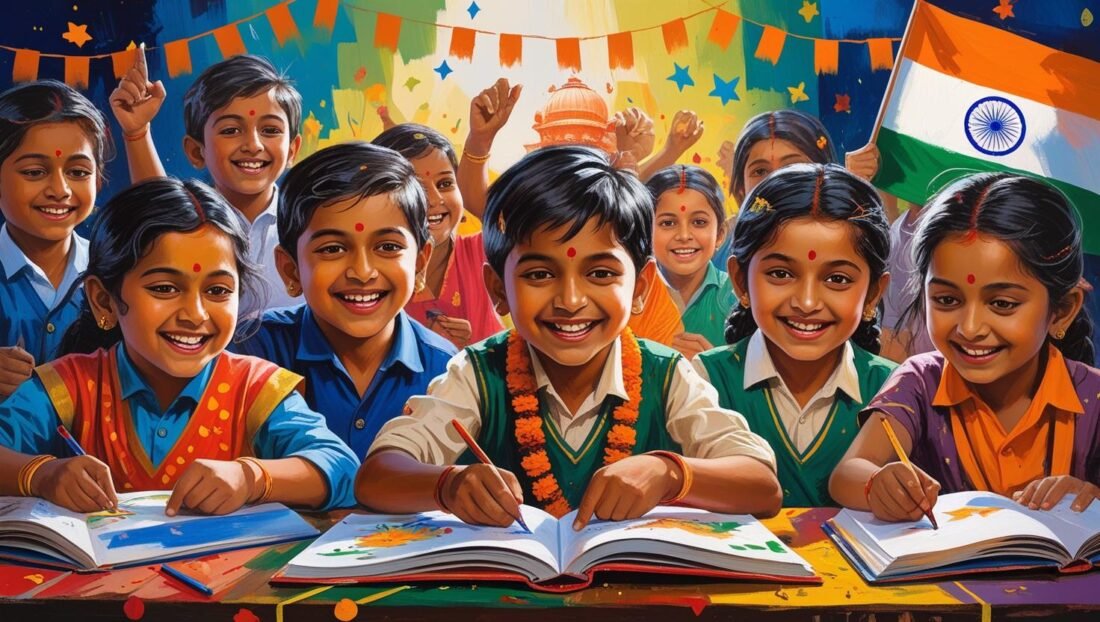
As India marks its 79th year of independence, the nation’s education landscape reflects both remarkable progress and pressing challenges that could shape its future trajectory.
Government data and global assessments reveal that school enrollment has reached highs, with primary and lower secondary completion rates surpassing the South Asian average.
Female enrollment has risen by nearly 40%, signalling a breakthrough in gender parity.
The country’s higher education sector is also going global, with institutions like IIM Ahmedabad opening overseas campuses and India positioning itself as a hub for international students.
At the policy level, the National Education Policy (NEP) 2020 remains the central reform blueprint. It promises universal foundational literacy and numeracy by 2025, mother-tongue instruction till Grade 5, a restructured school system, and stronger vocational pathways.
Initiatives such as NIPUN Bharat, SWAYAM, NPTEL, and the National Digital Library aim to widen access and bridge quality gaps.
Yet, experts caution that access is not the same as achievement.
The latest Annual Status of Education Report survey shows only 48% of Class 3 students meeting age-appropriate reading levels.
UNESCO data indicates India is still 11 percentage points behind global benchmarks for minimum reading proficiency. Teacher shortages—estimated at over one million—continue to strain classrooms, particularly in rural and underserved areas.
Infrastructure disparities persist. While urban schools edge closer to digital readiness, only 18% of rural schools have internet access. Basic facilities like functional toilets and reliable electricity remain missing in thousands of institutions.
Funding also lags behind ambition. India’s public spending on education hovers around 3% of GDP—well short of the NEP’s 6% target and the UN’s Sustainable Development Goal benchmark of 4%.
Dropouts remain a concern, with nearly one in six undergraduates leaving before completing their degree.
Inequalities—rooted in geography, gender, caste, and language—continue to exclude millions from the promise of quality education. Mental health, too, is emerging as a crisis, with student suicides accounting for 7.6% of all such cases nationwide.
Educationists argue that the coming years must focus on strengthening foundational learning, boosting teacher recruitment and training, bridging the digital divide, and integrating mental health support into schools.
Without sustained investment and consistent policy execution, they warn, India risks falling short of its demographic dividend potential.
In its 79th year of independence, India’s classrooms stand at a critical crossroads: the groundwork for an inclusive, world-class education system has been laid, but the real test lies in turning vision into reality—one school, one student, and one teacher at a time.