Nagaland University Launches Historic Project to Develop Grammar for 18 Naga Languages
EduNe Bureau
Kohima: In an initiative to preserve linguistic heritage and strengthen mother-tongue education, Nagaland University has joined hands with the Directorate of School Education, Government of Nagaland, to develop written grammar for the state’s 18 recognised languages.
The project aims to fill a critical gap in the teaching-learning process, as Naga languages—though taught in schools for decades—have never had dedicated pedagogical grammars.
The effort will create structured grammar resources covering parts of speech, tense and aspect, phrase and clause structures, tone, enriched vocabulary, and clarified orthography. These resources will be included in school textbooks for Classes 5 to 12, in alignment with the National Education Policy (NEP) 2020. Teacher training programmes and refresher courses hosted by Nagaland University are also planned to ensure smooth classroom integration.
The project is being led by Dr. Mimi Kevichüsa Ezung, Associate Professor and Head of the Department of Tenyidie at Nagaland University. Tenyidie, the standardised form of the Angami language, is already taught at higher levels, including postgraduate and doctoral programmes.
Calling the initiative both a cultural and academic mission, Nagaland University Vice Chancellor Prof. Jagadish K Patnaik said, “This endeavour is not merely an academic exercise but a cultural mission – one that seeks to preserve, strengthen, and promote the linguistic heritage of our people.” He added that the work aligns with the NEP 2020 vision of education in the mother tongue and reflects the university’s commitment to nation-building.
Dr. Ezung underlined the cultural significance of the project, noting, “A written grammar is a formal representation of the abstract properties of a language. At a time when Naga languages are undergoing standardisation, developing pedagogical grammars is crucial. It ensures consistency and instills pride in one’s mother tongue. This is not just about textbooks, but about preserving identity, culture, and indigenous knowledge.”
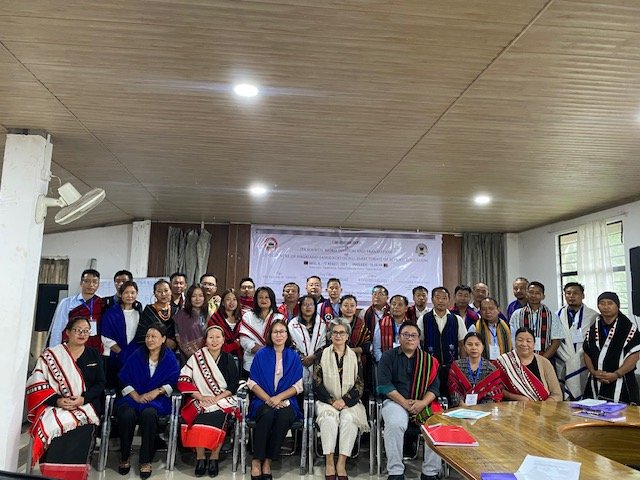
The initiative is a collaborative effort involving Literature Boards of the respective languages, the State Centre of Naga Languages, the State Council of Educational Research and Training (SCERT), and the Nagaland Board of School Education (NBSE). Technical workshops are being held at Nagaland University to train language officers in documenting and translating grammatical categories.
Stakeholders have welcomed the move, describing it as a vital step toward cultural preservation and linguistic empowerment. Mr. Kaitunchap (Joshua) Newmai of the Liangmai Literature Board said the effort would “safeguard cultural heritage and ensure Naga languages thrive for future generations,” while Ms. Kevileno Angami, Commissioner and Secretary of the Department of School Education and SCERT, emphasised that teaching grammar from early stages would “give clarity, prevent confusion, and build a strong foundation in language education.”
The project will cover Ao, Chang, Chokri, Khiamniungan, Konyak, Kuki, Kuzhale (Khezha), Liangmai, Lotha, Nthenyi (Southern Rengma), Nzonkhwe (Northern Rengma), Phom, Pochury, Sangtam, Sümi, Tenyidie (Angami), Yimkhiung, and Zeme. At present, only a handful of these languages, including Tenyidie, Ao, Lotha, and Sümi, are taught beyond Class 8. The grammar-writing initiative is expected to pave the way for the expansion of other Naga languages to higher levels of education.
Founded in 1994, Nagaland University is the state’s only central university with campuses in Lumami, Kohima, and Medziphema. With 43 departments and 76 affiliated colleges, it continues to serve as a hub for knowledge creation, cultural preservation, and academic excellence in the state.