EduNE Bureau
Kohima: A study from Nagaland University has opened fresh possibilities for India’s National Quantum Mission by demonstrating how fractal patterns found in nature can be recreated and harnessed in the quantum world.
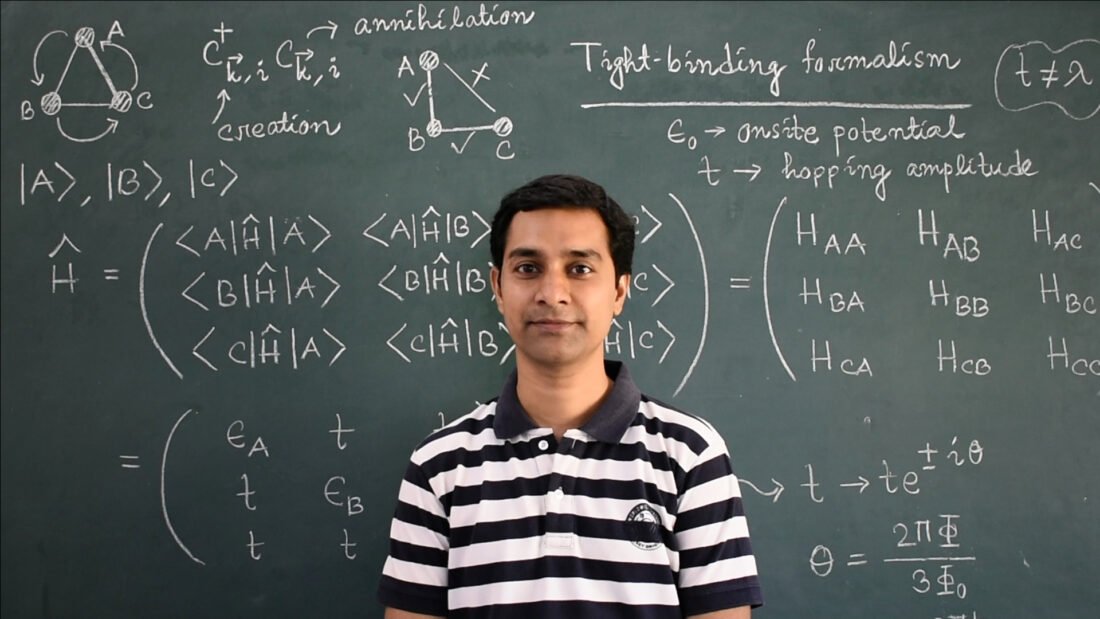
The research, led by Dr. Biplab Pal, Assistant Professor in the Department of Physics, School of Sciences, has been published in the internationally respected Physica Status Solidi – Rapid Research Letters (Wiley-VCH, Germany) and has earned a place on the cover of its latest issue, marking the work’s global significance.
Fractals—repeating patterns seen in snowflakes, coastlines, tree branches, or neuron networks—are more than natural curiosities. Dr. Pal’s study shows that these complex geometries can be used to understand how electrons behave under magnetic fields when confined in fractal systems. Unlike conventional research that relies heavily on crystalline materials, his work demonstrates that amorphous, non-crystalline materials also hold tremendous potential for quantum device design.
The findings point to exciting possibilities for the future. They highlight how fractal geometries can pave the way for molecular nanoelectronic devices, improved electron-state control for quantum computing, and even applications in quantum memory and logic systems through phenomena such as the Aharonov-Bohm caging effect.
Congratulating Dr. Pal on the achievement, Vice Chancellor Prof. Jagadish K. Patnaik said the research marks an important step for India’s National Quantum Mission, showing how naturally inspired geometries can meaningfully shape the technologies of the future.
Speaking about the uniqueness of his work, Dr. Pal explained that most advances in quantum technologies have been built upon crystalline structures. His study, however, proves that amorphous and non-crystalline materials can also be engineered for nanoelectronic devices, significantly widening the scope for innovation in the field.
By bringing together the elegance of nature’s fractals and the precision of quantum mechanics, the research not only strengthens Nagaland University’s presence in global science but also underlines India’s growing momentum in the global race for quantum technologies.