EduNe Bureau
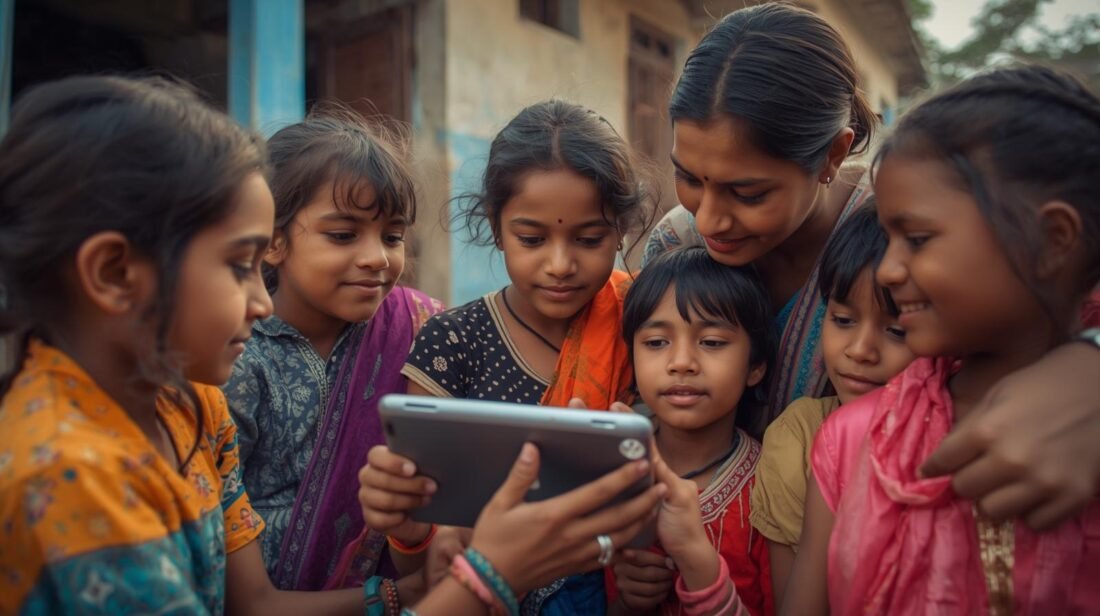
Guwahati: A recent survey showing an average of 1.5 smartphones per household in urban India and 1.3 in rural India has opened the door for high-quality educational inputs to reach children across the country, irrespective of their socioeconomic background.
Educational nonprofits have been quick to seize this opportunity, using technology to bridge learning gaps and make education more inclusive.
Rocket Learning, a nonprofit launched in 2020, delivers interactive, contextualised educational content in local languages directly to teachers, parents, and children through micro WhatsApp groups. Meanwhile, Chimple, an Android app developed in India, uses games to strengthen foundational literacy and numeracy. In a pilot study in Haryana, Class 1 and 2 students using the app for just 10 minutes daily showed a 50% improvement in test scores over a year, with struggling learners benefiting the most.
For older students, emerging technologies like generative AI are enabling new personalised learning opportunities. Personalised Adaptive Learning (PAL) allows children to learn at their own pace, moving beyond the one-size-fits-all approach of conventional classrooms. The Central Square Foundation (CSF) is partnering with Khan Academy to adapt Khanmigo, India’s AI-powered personal tutor, for low-income students. Andhra Pradesh has already pioneered PAL as part of its World Bank-backed Supporting Andhra Learning Transformation (SALT) programme.
AI is also revolutionising the creation and delivery of learning content, from generating rhymes, scripts, and worksheets to providing multilingual translation, dubbing, and animation. On the backend, AI tools analyse student responses and teacher feedback to refine educational programmes. CSF is working on an AI-powered teacher coach to provide actionable classroom feedback and reduce teachers’ workload through faster grading and detailed student performance insights.
To help governments and schools make evidence-based choices, CSF, along with IIT Bombay and IIT Delhi, has created EdTech Tulna, an evaluation index that sets quality standards for edtech products. The platform offers toolkits, training, and product reviews to guide decision-makers, particularly those serving low-income students.
With the combined power of smartphones, AI, and nonprofit innovation, India’s education sector is witnessing a quiet revolution—bringing personalised, affordable, and high-quality learning within reach of every child.