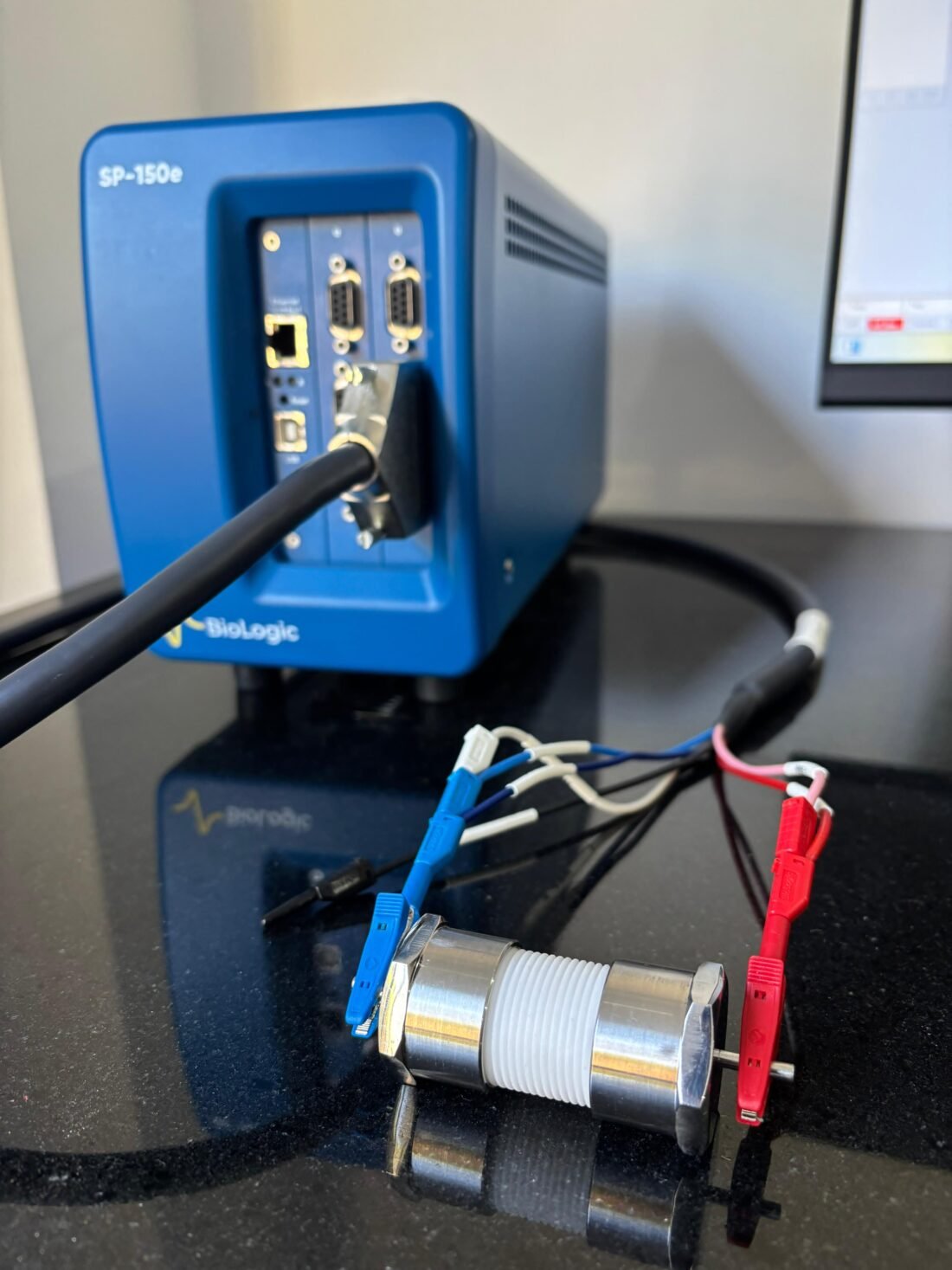
Kohima: In a major leap for India’s clean energy innovation, scientists from Nagaland University have developed a flexible supercapacitor capable of powering wearable electronics, electric vehicles (EVs), and renewable energy systems. The breakthrough device—built and demonstrated at the university’s Advanced Materials for Device Applications (AMDA) Lab—marks a milestone for both the institution and India’s growing research ecosystem in advanced energy storage.
Led by Dr. Vijeth H, Assistant Professor at the Department of Physics, and Research Scholar Pewe-u Marhu, the team became the first to compare tungsten, vanadium, and cobalt doping in molybdenum diselenide (MoSe₂) for energy storage. Their study, published in RSC Advances (Royal Society of Chemistry), revealed that cobalt-doped MoSe₂ (Co@MoSe₂) outperformed the others, delivering an energy density of 34.54 Wh/kg and maintaining stability over 10,000 charge–discharge cycles, even after repeated bending and twisting.
“This device combines flexibility, high energy density, and long-term durability—key requirements for next-generation electronics and electric mobility,” said Dr. Vijeth, adding that the eco-friendly hydrothermal synthesis method used makes industrial scalability feasible.
Beyond wearables, such flexible supercapacitors could enhance regenerative braking, improve acceleration, and extend EV battery life, contributing to India’s Atmanirbhar Bharat vision by reducing dependence on imported battery technologies.
The research, fully conducted at Nagaland University with advanced characterisation support from the Indian Institute of Science (IISc) Bangalore under its INUP program, received funding from the Anusandhan National Research Foundation (ANRF).
Marhu noted that the next phase will focus on improving safety with solid-state gel electrolytes, optimizing performance, and scaling up for pilot production through industry partnerships.
Founded in 1994, Nagaland University—the only Central University in the state—has steadily emerged as a hub of scientific progress, recently securing a place in the 151–200 rank band in NIRF 2025.
With the rising demand for efficient, flexible, and sustainable power storage, this innovation positions Nagaland University and the North East at the forefront of India’s energy technology transformation.